Memory
db- declare byte (8b)dw- declare word (16b)dd- declare doubleword (dword) (32b)dq- declare quadword (qword) (64b)
a db 5
b db 10, 20 ;basically an array with 2 elements
ten equ 10  ;ten is a constant
c dw 0123h, 0ABCDh, 0xAB12 ;if a hexa number starts
						   ;with a letter
				   ;you must precede it with a 0,
				   ;the assembler will consider it a
				   ;variable
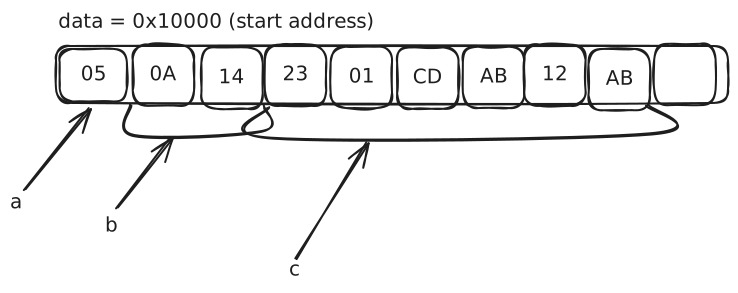
a isn’t a value, it is the address of the data segment plus an offset
ten doesn’t reserve memory
Endianness
Intel proccessors are little endian,
= The reason for this is that the least significant bits are put first, because they have a lower index
a db 001101b       ;binary number
b db 'a', "abcd",0 ;you have to put the null terminator
				   ;manually
List of registers
EAX,EBX,ECX,EDX,ESI,EDI- all purpose registersESP, EBP, EIP, EFLAGS- control registers, don’t use
Instructions
MOV instruction
mov destination, source
MOV EAX, 2; register, immediate
MOV EAX, ten; register immediate; <=> MOV EAX, 10
Important
You cannot have both operands of type memory
MOV BYTE [a], 10
MOV [a], 10 is wrong because the assembler must know the size to overwrite.
MOV a, 10 is wrong because it replaces the address, not the content at that address.
MOV EAX, [a] will read 4 bytes starting from a, (because it knows how big EAX is)
MOV EAX, BYTE [a] wrong because operand sizes must be equal
MOV AL, BYTE [a]
ADD instruction
ADD dest, source <=> dest=dest+source
SUB instruction
SUB dest, source <=> dest=dest-source
MUL instruction
MUL BX<=>BX\*AX=DX:AX
DIV instruction
DIV BX ;DX:AX/BX AX - quotient, DX - Remainder
Convert instructions for signed numbers
CBW, CWD, CWDE, CDQ (fill the higher part with the most significant digit)
CBW ALAX (signed conversion)
CWS AXDX:AX, AX=
CWD DX
CWDE AX EAX
CDQ EAXEDX:EAX
Example
a db 5
b dw 320 ;a+b
mov AL, BYTE [a]
mov AH, 0
add AX, WORD [b]unsigned 251, signed -5 (2’s complement)
Exercise
data
a db -10
b dw 325
c db 5
d resw 1 ; d = a+b-c
code
start:
MOV AL, [a]
MOV AH, 0
CBW
ADD AX, [b]
MOV BX, AX
MOV AL, [c]
CBW
SUB BX, AX
MOV [d], BX